
The short answer
Mailgun is billed per monthly email volume. It has a free tier: 100 emails/day (forever). The paid plans we list start at from $15/mo (Basic).
Plans and prices
| Plan | Price | What it covers |
|---|---|---|
| Free | $0/mo | Up to 100 emails/day, API access, one sending domain, basic tracking, ticket support |
| Basic | from $15/mo | 10,000 emails/month, no daily limit, webhooks, one custom domain, two API keys; ~$1.80/1K overage |
| Foundation | $35/mo | 50,000 emails/month, email templates, up to 1,000 sending domains, 5-day log retention; ~$1.30/1K overage |
| Scale | $90/mo | 100,000 emails/month, 5,000 validations, dedicated IPs, send-time optimization, live chat, 30-day log retention; ~$1.10/1K overage |
| Enterprise | Custom (contact sales) | High-volume senders, burst/rapid-fire sending SLA, custom infrastructure and response-time SLAs |
How Mailgun bills you
The pricing model is per monthly email volume. Mature developer-focused API with a 99.99% uptime SLA, broad SDKs, and strong validation/analytics add-ons. Best suited to: developer email infrastructure at scale.
What to watch for on the bill
- Pricing escalates steeply with volume; reviewers say it has gotten 'pricier and pricier'
- Legacy pay-as-you-go Flex plan doubled to $2.00/1K in Dec 2025 and is closed to new users
- Support quality is inconsistent on lower tiers despite a high review-response rate
The pricing page we read
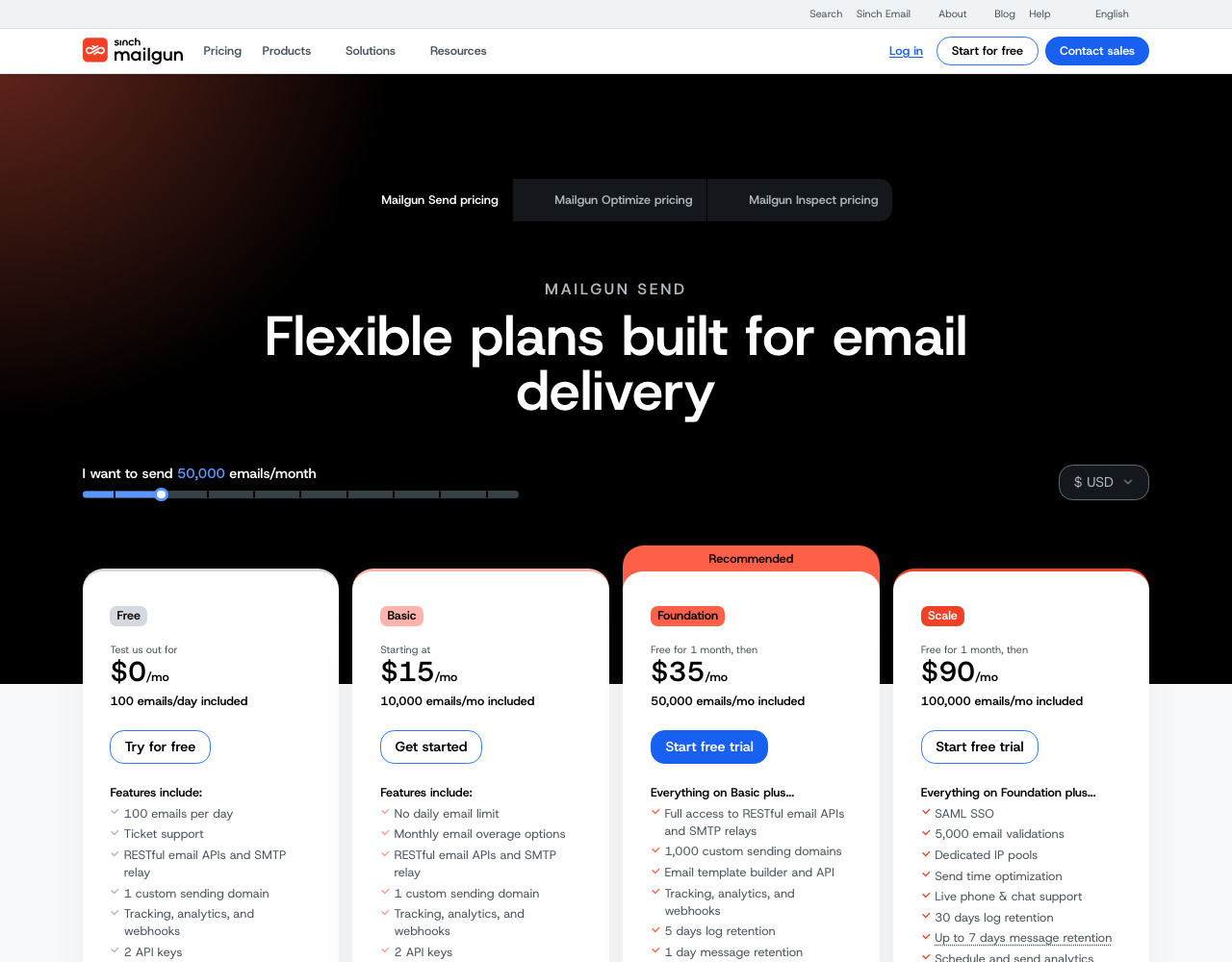
Source: https://www.mailgun.com/pricing/. Prices change, so confirm there before you commit.
Compare Mailgun with alternatives
Other transactional email apis: SendGrid, Resend, Postmark, Amazon SES, Loops.
Looking at quality rather than price? See the Mailgun score on APIbenchmarks. Full entry: Mailgun pricing.